










Listen on your favorite podcast platform: Spotify | Apple Podcasts | Acast
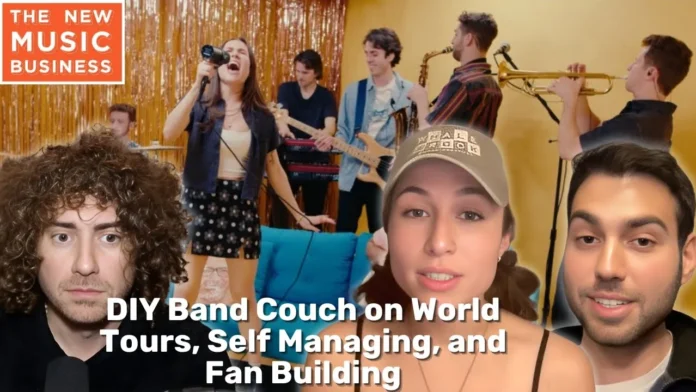
This week on the New Music Business podcast, Ari sits down with Tema Siegel and Zach Blankstein of the band Couch. Tema is the singer and Zach is the guitarist/manager of this seven-piece soul-pop band from Boston. Their explosive live shows and fully DIY approach have helped them sell out major venues across the country. Formed from lifelong friendships and built during the pandemic, Couch has grown into a globally touring act while self-producing their acclaimed debut album ‘Big Talk’.
In this episode, Tema and Zach break down how they built an engaged fanbase without label support, the logistics of touring as a seven-member group, and the creative and vulnerable writing process behind ‘Big Talk’. Ari dives into their ad strategy, their partnership with the Salt Lick Incubator, how they secured major support tours with Lake Street Dive and Cory Wong, and what it takes to balance musicianship, management, and sustainable growth as an independent band in 2025.
http://instagram.com/couch.theband
07:16 – Adding the seventh member & early chemistry
09:15 – Touring as an introvert and finding group balance
12:19 – Managing a 12-person touring party
16:34 – How fans are reacting to the new songs live
18:22 – How the band uses VIP sections to build superfans
19:40 – Collaborative songwriting process & Temma’s Notes app
22:19 – “Middleman” and the band’s unexpected EDM influence
26:22 – Self-producing the entire album & working with mixers
27:15 – Living in Boston and breaking out beyond the local scene
32:56 – Growing during the pandemic while in separate cities
36:32 – Early viral video & their online strategy
40:07 – How Couch finances the band with day jobs
41:24 – Why Zach became their in-house manager
55:52 – Opening for Cory Wong & Lake Street Dive
58:44 – Deep dive into their ad strategy
Edited and mixed by Peter Schrupp
Music by Brassroots District
Produced by the team at Ari’s Take
Order the THIRD EDITION of How to Make It in the New Music Business: https://book.aristake.com
Episode Transcript
View Full Transcript
Ari Herstand: Speaking of the Salt Lake Incubator, you’ve referenced it a couple times. Tell me about it. They’re an artist development program that offers grants between $5,000 and $15,000 to independent artists who have never taken in advance before. They have this very thorough application about how the band or artist functions, their process of creating music, what they would use the funds for. And I respect the level of specificity they’re looking for and how those funds will be used to make sure they’re really bringing in artists who, who will care for that gift. And it’s no strings attached. But more importantly than the funding, though that helped us mix and master our record, they just have this incredible team of artist support, a board of musicians that includes like Susan Tedeschi and Jon Batiste, and a team of young interns who are getting into the music industry with skills but haven’t had the opportunity to use them at a label or somewhere else yet. And then a leader of all this who I mentioned before, Eliza, who just has a deep passion for artist development and worked at many different labels. She was at UMG, I think she spent some time at Sony, and put putting together all of those experiences and just wrapping them up beautifully and gifting them to artists like us. What’s going on? Welcome to The New Music Business. I’m your host, Ari Herstand, author of How to Make It in the New Music Business, the book. Third edition is out now everywhere, hardcover, ebook, audiobook, however you like books, you can find books, find the book. Today, my guests are Zach Blankstein and Temma Siegel from the band Couch. Couch is a soul pop funk project out of Boston. They are all currently still based in Boston, have an interesting beginning story, kind of forming and developing over the pandemic when they were out at school in multiple different cities. We get into all of that. They’re very successful. They’re on tour right now, a world tour. We talked kind of midway through their US leg of the tour where they’re playing massive rooms. They’re playing the 930 Club in DC, the Fonda out here in LA, Brooklyn Steel in New York and their Boston hometown Boston show at Roadrunner. That’s a 3,500-cap venue. They are a completely DIY independent band. No label. Zach actually is the guitarist in the band and he is the manager of the band. Tema is the lead singer of the band. So we, we kind of dip between both talking the business and the creative and the music. They have a new album out. Called Big Talk. Definitely go check out this album. I love this album. I’m a Big Couch fan. I actually hit them up a couple of years ago to come on the show because I was obsessed with this song Jesse. It was on repeat. This bass line, it’s out of control. You got to go check it out. And I was like, yo, you guys want to come on the show? They’re like, well, how about when we release our new album? So here we are. Fast forward a couple of years. They’ve released their new album. It’s phenomenal. They made their national TV debut on CBS Saturday Sessions. You can watch some of those videos on YouTube. You can listen to their new album, Big Talk, wherever you listen to music, you can find it. Check out some of their tour dates, go check them out around the world. They’re doing a big Europe leg last year, and recently they toured with Corey Wong and Lake Street Dive. They talk about kind of those opening tours, how they got those tours, and just kind of how they got a lot of their opportunities. We dive deep into the weeds on a lot of the stuff. I mean, I even talked to Zach, I asked Zach his ad strategy I mean, how much they’re spending on ads, how they’re running ads, who they’re targeting, all of that stuff. And then zoomed out, I mean, we talk about there’s, there’s 7 members in this band and there’ve been 7 members in this band since the beginning. How do they make this work financially, creatively, emotionally? We touch on all of this. Now, this is, as you’ll see if you look at the timestamp, there’s a little bit longer of an interview than most of the New Music Business episodes. That’s just We, we got on one. Uh, they, they were really open about this, and, and Temma even talks about kind of the subject matter, if you stick around to the end, of one of her songs where she discusses kind of power dynamics in the industry and just how she has experienced some of that, especially with older men, which is prevalent on the song What Were You Thinking, their first single that they released from this. Uh, the whole album, top to bottom, is fantastic. They played On the Wire. That’s a standout song for me. Played it on CBS Morning. But the whole album, definitely check it out. Find Couch everywhere. It’s just Couch the band on the socials and on the streaming services. Find all of us that makes the show happen at Ari’s Take on the socials. Find me at Ari Hurstand on Instagram. But right now, if you wouldn’t mind, pause this episode, leave us a 5-star review on Spotify Podcast, Apple Podcast, however you’re listening to this. Give us a thumbs up on YouTube, hit the subscribe button, hit the follow button, and visit Ari’sTake.com and get on the email list. That’s actually the best way to stay in touch with us. Get on our email list, aristake.com. All right, let’s kick it in the show. Temasego, Zach Blankstein, welcome to the show. Thank you.
Guest: Thank you.
Ari Herstand: Yeah, um, so I— yeah, I didn’t know if I was gonna get all 7 members of Couch, uh, but we will, uh, it’s— I, I’m, I’m happy to see both of you, and it’s an interesting It’s an interesting setup that you guys have with this band being kind of this indie DIY operation, Zach being the guitarist and the manager. Tell me, like, before we get into the, the new record, which I love, by the way, and I’ve been listening to on repeat since you sent me the private streaming link, which made me feel very cool when you did send me that. I believe it was even unmastered at the time, but Before we get into the new album, which we will spend a lot of time talking about, tell me how the band came together. Tell me how not only did it come together, but also how you have figured out how to make it work with 7 fucking people in a band for so many years, because I can barely make something work with one person, let alone— and all of my split personalities. And but yeah, Tell me, tell me. Yeah, whoever wants to start. Yeah, I feel like— Yeah, give it to me. Part of why it’s worked with 7 people is because of how we met. Most of us are friends from high school and middle school. Okay. So there were these preexisting relationships before the band, both musical and non, that led to us enjoying spending time together and wanting to work together. So Danny and Danny, our keyboardist and Timbre, for example, went to high school together, played music there together. I was a music teacher with Danny to elementary school kids on the weekends in high school. And there’s just this huge web of every person knew someone else and couch through something like that in the Boston area, with the exception of our drummer Jared, who I met in college and had like— you go to school? GW. Actually repping right now. Oh, okay. Right on. We had like a School of Rock moment where I saw him through the practice window playing drums and we needed a drummer. And I was like, who is this? It was— he was a freshman at the time, so I had never met him, never heard him. And I’m like peering through the window watching him play. And then he noticed me watching him and I ran away. And then later that semester I was like, were you that guy drumming? And eventually he, he was the missing piece. But all of it really stemmed from like childhood friendships, which makes now doing this together so special and I think easier. Yeah. If we had hired out 5 other people. Yeah, I mean, right, because it can’t be easy touring as a 7-piece operation or even functioning as a 7-piece operation. But I guess if you have that foundation of just like respect and understanding and just like friendship bonds or like going way back, like it’s— you’ve probably been through a lot just personally, let alone musically and professionally.
Guest: Absolutely. It also— we’ve, we’ve gelled more and more over time, I think mainly because of Twitter.
Ari Herstand: Yeah.
Guest: As Zach noted, my main connect to the group early on was Danny, our keyboard player. But until college, that was it. And so I befriended these guys as I became their bandmates, as I got invited into that fold. And for me, touring used to be more challenging socially because I’m also pretty introverted. And so getting to know these guys while I was also wiped out and needing alone time was a challenge. But we have seen each other through highs and lows, as you do as you tour, and come to be a lot more comfortable communicating our needs with each other. And so it’s become a very intimate kind of group. I think of them more like brothers than anything else. And so I’m actually thinking of them as brothers makes it easier to have moments of tension and frustration because I know that I can get to the other side of it and still feel a lot of love for them.
Ari Herstand: Yeah, I love that. Speaking of touring, you are like not currently in this second on tour because I believe you’re at home, but you are mid-tour, mid mid-tour for Big Talk. How’s it going so far? I mean, the photos and videos I’m seeing look amazing, but you tell me how how it’s, it’s been so far. Yeah, we’re home for, for 2 days between a show in Philly and a show in DC we just played. So far, so good. We’re 7 shows in. We have 12 people out with us this time. So in addition to looking out for each other, now we have some crew with us. Additional audio, lights, content, all of that stuff. And it’s been great. On Saturday, we played 930 Club. And as someone who went to school in DC, I like went there every weekend for shows. And I would always— Jared and I would say like in our college band, like, oh, it would be so cool to play here one day. And then we did on the Saturday. And Tema’s parents were there and there was a song dedicated to them. And it was just sort of this like culmination of emotions and relationships that have led up to a tour of this size for us. Um, and that’s what we’re coming off of right now. So it’s good to kind of breathe after that one and be home for a couple days. Yeah, that’s so cool.
Guest: It’s also pretty epic because the shows that we’re going into this weekend are Philly and Boston. Boston being our hometown and the biggest headline show we’ve played to date. Uh, it’s a 3,500-cap room and we have tons of family, friends, mentors, other musician peers that are going to be there. And so it feels really cool to kind of have 2 days to restore ourselves and then continue to, like, feel the momentum and the hype going into a show that I think all of us would say is our most anticipated show.
Ari Herstand: Yeah. Is it hard to start and stop like this? I mean, I feel like once you’re on the road and you’re in motion and you have a routine going and you have your suitcase, and where everything fits neatly in the van or the bus or however you’re touring right now. And then to have to go back home and have it all halt for a couple of days and like, am I unpacking? Am I packing? I forgot this one thing. That’s great. But now I have to get back on the road. And then your first show back is going to kind of like maybe— well, I guess at least the first show back is not in Boston. So you don’t have to feel like it’s a local show and then you’re running back and forth from your place. A thousand times because you forgot this or that? Yeah, there’s kind of two things to it. I saw my parents this morning and they were asking me all these questions that normally would come at the end of tour. And I was like, I’m not— I haven’t decompressed at all or thought about any of these things yet. I’m, you know, and that was overwhelming and funny and just like classic Jewish parents foot on the gas right when I’m home. Um, but also, like I said, we have a bigger touring party, bigger crew. A lot more work with the amount of production. So people being able to rest for a few days before such a big show for us is huge. And my ability to check in with everyone in the touring party individually in the comforts mostly of their own homes where they can also decompress for a second and be like, are you good? Do you need anything for these next two shows? And then also importantly with the crew on a production and business sense, like, are we executing? Are these going well? How can we improve? Which normally in the middle of a leg we would wait until in between. And it’s so perfectly timed that right before our biggest show ever, we can really go, are we dialed in enough to pull this off the way we want to? What, what kind of things are you planning? I mean, is this Boston show going to be different from other tour stops because it is hometown, because it is so big? There’s a couple added production elements, some stuff we had to get special permits for and things like that off how we want it to do. Got some pyro going on. What’s happening? Some fast dissipating water-based things so that the permits weren’t that expensive. Okay, well, we’re doing— we’ve been doing a pre-show VIP on this tour. This is going to be the biggest one because all of our parents are going to come too and celebrate with us, um, among some other tricks. Yeah, sick. Um, cool. Well, I, uh, I have a million questions about the tour and the logistics of that, and Zach, you alluded to some of that being the which I do want to get into, but I want to start with Big Talk because this, uh, this is your, your debut full-length album. Uh, first off, congratulations on that. It’s great. It’s, it’s awesome that it’s out in the world now. How does it feel that this is now in the world and you’re getting feedback on it? Are there any surprises so far now that you’ve had a leg of the tour? How are people reacting to the songs live? Tell me about it. How is it feeling right now? Tema.
Guest: Oh my gosh. Um, I mean, truthfully, it feels, um, I feel like some days I really feel it and some days I don’t, you know. Some days I, I’m like, oh my God, I cannot believe we finally, after, you know, like 6 years of being a band, we finally have a full-length project out. Um, we finally doubled the size of our catalog. We finally have to make cuts from our set list rather than trying to squeeze in every song.
Ari Herstand: Yeah.
Guest: So I feel that. And then other days we get sucked into the grind of the tour and of rehearsing and tightening all the screws. And I forget to kind of celebrate and feel the pride that I think we should feel right now. But it is very rewarding to see people singing along at the shows. You know, we talk so much as we as we build our setlist about how to keep people engaged. And okay, if we’re going to play a bunch of new songs, we got to throw in a recognizable old song that they love to sing along to afterwards, just in case we’ve started to lose some of their attention. Oh, but we think this new song would be such an amazing way to end the show because it’s so high energy. But what if people are disappointed that we’re not ending the show with the song they already know? And so it’s made for some really interesting kind of strategizing in terms of the show build.
Ari Herstand: Yeah. Do you find— I mean, and how has the audience reaction been to the new songs? Are they singing along or are they still kind of still feeling like they’re there for the old music?
Guest: Right. I was building toward that and forgot to kind of finish the thought process.
Ari Herstand: I got you. I got you.
Guest: Thanks for asking. No, I think, you know, you can still feel a difference with like when we play Easy to Love, for instance, which is like our most streamed song versus some of the new stuff. But people are singing along in unexpected moments too. There are like bridges that I thought would be too wordy for people to have sunk their teeth into by the time we would be taking them on the road. And we are hearing people sing. And that’s one of the things that I try to pay the most attention to. It’s like a way that I can kind of most tap into the “Oh my God, this is working” kind of feeling when I, when I pull an ear out during a moment that I think might be too new for people to know when they are singing along.
Ari Herstand: Yeah. How’s it feeling for you, Zach? It’s been amazing. It’s been a lot of work for the whole band. I think the physical labor side of it has been the most surprising, just loading in and loading out lights and setting them up. We’ve only ever had to worry about really our own instruments. And so all of that stuff doubled. But I think it’s also been like the shows have now been the most fun because there hasn’t been as much time for like the hangs and stuff. So like the hang with each other is actually on stage on this tour. And I feel like we’re releasing so much pent-up energy and stress from the day leading up to each show. And then we actually just have the release and it’s like definitely nice if in the morning we can have a chill breakfast and and get those hangs in. But I think the absence of those have allowed us to like have that point of connection as friends be on stage. And I think since the part of our VIP is that they can come in early to the venue after the program and get a good spot, it just happens that like some of the people who are most excited about this new music are up front every night. And so the exact type of person you would want to be feeding off of is going to be there singing that bridge that we weren’t sure if people would know the words to yet. And that’s been super fun. Yeah. Cool. Let’s talk about some of these songs. How did the record come together? Was this a similar process that you’ve had in the past? Tell me about how you guys first write the songs and then how you recorded this record and just the whole process of putting this album together. Start— let’s start with writing.
Guest: Yeah. Yeah, our writing process has become very collaborative over time. So you could point to a different song on the album and we could tell you, oh, this was Danny’s seed. You know, he came up with the chord progression and the melody for, say, Slow Burn and brought it in. Or Will came up with the bass line and the groove for On the Wire and brought that in. Every song kind of came from a different person. And then I play a big role in lyric development. We talk a lot about my, like, big notebook that I flip through, which is really just the Notes app on my iPhone. I do have a notebook too. I’ve been trying to work with paper as a medium a little bit more to see if that helps me flow better, but certainly convenient to have everything in one place everywhere I go. And so, in these instances of, you know, Slow Burn and On the Wire, the songs I just referenced, I got to hear the beginning of a musical idea from one of the boys and then say, “Oh, what does this make me feel? What kind of mood does this put me in?” And then I’d scroll through my Notes app and pull up a concept that I’ve been kind of thinking about and wanting to develop further that paired with their idea. That’s how a lot of ideas on this project came about. So Myself, I think, is the only one that began lyrically and actually melodically and chords. All of that I brought in. It was something I started in college and never thought would become a couch song because it didn’t feel like soul pop funk. But that was part of the joy of this project. We started to embrace whatever genre we were in the mood to make. And that made it Couch.
Ari Herstand: Let’s talk genre for a second. I mean, the album, it does— you guys have definitely settled into a vibe and a sound. And it’s— I mean, yeah, you put it in quotes, the soul pop funk. I guess that’s just kind of where you like to position yourselves or what you call the style of music you make. I mean, genres are pretty irrelevant these days. I don’t think I don’t think anyone really even know, you know, who knows what a genre is like. What do we call Rosalía? What’s her genre? She just came out with an orchestral album, you know, and it’s kind of like, where’s every, where’s genres? And, you know, Spotify playlists are classified under moods and vibes and feelings and whatever. But that being said, I’m curious about, I mean, the feature track that you guys are pushing alongside of the album, Middleman, which actually was the one to me that, that felt the most like it was kind of maybe could be a different project or different band. I mean, you got— it’s still Couch, you’re still playing it, but it’s like I’m listening to it for the first time, like, is— did I like jump over to an EDM, uh, like concert or something? I mean, it’s cool because it’s like this blend and this fusion of what you guys do with that style. I’m just so curious where that one came from because I hadn’t heard anything like that from you guys. There’s nothing else on the album like that one. And I was just fascinated where— yeah, where that song came from. Yeah, go ahead, Tamar.
Guest: Oh, I mean, that idea originated with Jeff. Jeff is our trumpet player, and he, he has gotten really into production over the last few years. And is kind of like the, the main member of the band who will bombard the chat with the most ideas and get the most— because he’s sending the most content, also faces the most rejection of ideas, but has become so, um, so like comfortable with that. And then as a result has contributed a bunch of excellent ideas to the album. So yeah, um, uh, Middleman was his brainchild, and he loves EDM. So, ah, well, that makes sense. I think all of us like appreciate EDM to some level, appreciate that like soul pop funk, this genre that we have been categorized within previously, the goal is kind of to make people dance. Um, I think that’s why it speaks to us so much and why we’re so compelled by his idea.
Ari Herstand: Mm. I mean, it is dance music. Like EDM, almost even that term is outdated. Like, like, I don’t even think anyone in the dance community really calls it EDM anymore. It’s kind of like EDM was very 8, 10 years ago, and it’s kind of like it’s just dance music at this point. You know, it’s all under the dance umbrella. And I, yeah, I would argue that, you know, your music is dance, not in the traditional, I guess if we traditional of what the dance community would consider it. How do you find, like, at your shows, are people dancing? Are people saying, like, what’s the vibe? I’m assuming it’s not like a rave. It’s a concert. They’re probably singing, but are people dancing? Yeah. Jumping? There’s dancing. I feel like our audiences, some are musicians themselves, and I can feel when a guitar player is watching me because they don’t move for an hour and a half. And they’re just staring at your pedalboard and your fingers. Exactly right. And then there are people who are singing and people who are dancing. Um, yeah, and I kind of like that because I feel like our band is made up of, in a large way, the people who would attend our concerts. Some of us would be dancing at our own show, and some of us would be staring at what the people are playing and analyzing the chords and trying to figure out what’s going on. And, um, this project in particular, like Tema said, was much more collaborative than things in the past. And I feel like the people who are now coming to our shows sort of reflects that wide range of types of people, just in the way the music and the influences behind it did too. Cool. And tell me about the recording production style. Did you work with a producer on this? How did you track it? Yeah, break it down for me. Yeah, it’s self-produced. Every song, we didn’t use any outside production. We had some great mixing engineers who we gave creative liberties to and allowed some creative processing. One I’ll shout out specifically from Middleman, this mixer producer named Tennyson is Jeff’s favorite EDM producer. And so to get him on the record was a really big deal for Jeff. And then we ended up giving him like 5 of the songs on the record because he was crushing the mixes so hard. We’ve worked with Caleb Parker, who does Scary Pocket stuff and did a lot of the Vulfpeck live stuff and Flyers. We’ve worked with him on everything. We totally love him. Matt Huber, another one. A bunch of different mixers on this project. Everybody crushed the assignment. But we had, because there’s 7 of us, that’s already a lot of cooks in the kitchen. And so we had a great time just doing it completely ourselves. And for the first time in an actual studio, we sort of had it fall into our lap, which was these guys from Telefunken, the microphone company. Came up to us after a show and were like, hey, we have this amazing state-of-the-art facility where we test out our microphones, but we don’t really have bands come in. Do you guys want to come make a record here? And a couple of the guys who work there started a company called Studio 60, which is just like friends from childhood, similar to what we’re doing. And we could feel that compatible energy of how they were building their business with how we’re building ours. And so they brought us into this amazing space and like for very, very little money allowed us to make a record of the quality that we wanted to. Amazing. Where is it? Where is it located? Connecticut. Okay, cool. So not too far. No. Are you all still based in Boston? You all live in Boston area? Yeah. How— like, how is that? I mean, do you feel the pressure to get out of Boston. I mean, you guys have kind of broken through the Boston ceiling. I— my wife’s from Boston. She’s a musician. She used to gig around Boston a lot. She went to MassArt out there and she grew up in Massachusetts. And, you know, she would talk about the Boston ceiling and how, like, there’s a lot of local bands that just kind of stay local and that you can’t really bust out. You guys have— you’re one of the few that have really broken out in a big way. I’m At this point, you probably don’t feel the pressures as much anymore because you’re doing what you want to be doing. You’re touring to packed rooms all over the country, all over the world. So maybe this might be— were there pressures previously? I know you’ve had songs about LA in the past where you’ve talked about your friends in LA and you’re like, “I don’t know if I want to get out to LA.” But yeah, maybe tell me about that journey emotionally or otherwise of just your hometown and what that means to you?
Guest: I think when we’ve all graduated college, which was between 2021 and 2022 or ’23, the move back to Boston sort of seemed temporary, and there was some dialogue about moving to New York or LA or another music hub after we’d gained some touring momentum. Now I think we are pretty settled. I personally don’t love the idea of staying long-term in my hometown. I would love to live somewhere else. only— I’ve the only other city I’ve lived in is Chicago, where I went to school. But we’ve all built community here. We all have family here, and it hasn’t felt like it’s held us back musically. But yeah, I like— I mean, LA is one of our only songs that really touches on that conversation. We— I certainly felt the pull to move there, but also wasn’t sure I would actually like it that much. Now I’m pretty confident I wouldn’t.
Ari Herstand: Um, hey, hold on now, hold on now. I don’t know if you’ve really given it a fair shake here. Let me— come on, have you been to Los Feliz? No, just kidding.
Guest: Visited like once a year, numerous years in a row. I’ve figured out which neighborhoods I think I could stand the most, and it would be like Los Feliz.
Ari Herstand: And the most— Echo Park.
Guest: I’m sorry, I’m sorry, but I, I.
Ari Herstand: Love— Los Feliz is the best neighborhood. Yeah, no, it’s true.
Guest: I love living in a walkable city. I love having a lot of like a neighborhood feel and a lot of greenery available to me.
Ari Herstand: And, uh, we got Griffith Park a half a mile up the road. No, I’m just kidding. It’s fine. I’m not gonna keep putting— making the hard sell. Yeah, yeah, yeah.
Guest: But LA does touch on that. And verse 2, it’s kind of funny. Verse 2 says, “You’re in Boston,” turns to “too sick and safe in hometown blues.” “You’re in Boston” has now turned to 4. I’m not living with my parents anymore, so that, that helps. I love them and living with them was wonderful, but I think moving into a different neighborhood, into my own apartment, helped me reset personally. And now we’ve all done that. Now I think we all feel like adults in Boston and not children who’ve moved back in with their parents.
Ari Herstand: I I remember— mean, go ahead. We opened for Ripe really early on. They took us out on one of our first real gigs and they— Los Feliz native. I just ran into them at the bar the other night. Yeah. I mean, they were in Boston for a very long time. Berklee band and everything. Yeah. And they asked how long we wanted to be in Boston. And we’re like, oh, we’re probably gonna move in the next year or whatever. And then they said, ha, we’ve been saying that for 10 years. I see how it happens. Yeah, no, it’s, it’s, no, it’s fascinating. And yeah, there, you know, I wasn’t planning to ask you about your song LA, but when you, when you say sell your soul, move out to LA, I’m curious, like, I know, I know that I know the energy of of what it is of like people outside of LA, especially in Boston. My wife’s told me many things about that, of how Boston, how, you know, assholes feel about LA you and, know, whatever. But no, it makes sense. It’s interesting. I mean, getting to the point of like, what was it that enabled you to break out of being a local band onto the national front? Was there an inciting incident? Was there a moment Was there a song, a viral video? Was there a cosign by an artist? Like, can you trace it back to a thing where it’s just like, oh, like, you know, the big break is out of date. It doesn’t really exist. But, but like, could you trace to something that was a stepping stone, at least to the moment where you’re like, huh, we’re not really a local band anymore?
Guest: Or yeah, I think it’s In a way, we never were a local band to begin with because we formed when we were already off in different cities at college, and we would only really play together when we were home on breaks. And so we didn’t get our start really rooted in Boston. We were building a presence online during the pandemic, and then our first show was in New York, and our first tour, we didn’t even play in Boston. We kind of wanted to wait until there was a room that felt appropriate for us. And unfortunately, a lot of the smaller clubs got hit during the pandemic. And so, we actually began outside of Boston.
Ari Herstand: That’s interesting. Tell me more. You said you’re building during the pandemic. How were you building during the pandemic? It’s the pandemic. There’s 7 of you. You’re in different cities at the moment. I would imagine you’re at school. I don’t know if you came back over that, but like, how did you build that? You go, Tamara.
Guest: Wow, I’ve been talking so much.
Ari Herstand: Okay.
Guest: Well, okay, okay. I thought Zach was gonna answer the question. So can you repeat the question?
Ari Herstand: I’m curious, how did you build over the pandemic? You said you were building over the pandemic when you’re in different cities and everything. Like, what does that mean, we’re building over the pandemic?
Guest: Yeah, I mean, okay, I feel like we’re a hardworking band. Zach in particular is an incredibly hardworking manager and has, I think, been the fire under our asses for the past however many years. But I also think that we kind of got lucky. Like, it was that preparedness meets What’s the quote?
Ari Herstand: Preparation meets opportunity equals luck. Yeah.
Guest: Yeah. Thank you.
Ari Herstand: Luck is just preparation meets opportunity.
Guest: Yeah. In that, like, weirdly the pandemic sort of served us. We were all off at different colleges, knew that we enjoyed making music together, but were obviously slowed down by physical distance and then by our studies. And so when the pandemic started, we suddenly had more time to be online and writing and recording virtually. And it also meant that no one was expecting us to play shows, so we could be building a presence online. And then by the time the world was opening up and we were ready to play our first gig, we already knew we had a bit of a built-in audience that we could invite to this show and that would be excited and eager to finally be able to see us play. So I think there’s a lot more to say on that if you do want to elaborate, Zach, but Yeah, that’s how we were able to build during that time.
Ari Herstand: We had never played a show at that point, so we didn’t have to stop touring and pull back what was making us money or what was bringing us in new fans. We just continued business as usual while we saw other bands have to completely rework their systems to be virtual with each other. That’s all we knew at the time. And, um, and just said, okay, this is how it’s going to be, just longer. So let’s keep doing what we’re doing, um, just in a more focused way. Yeah. And then, I mean, so yeah, you never were a local band, and it’s kind of just, um, I mean, who’s kind of— who’s the brainchild behind, or at least like guiding, the building online trajectory and even over the pandemic of just like, what was the strategy? I mean, I see like, you know, one of your earliest videos that went viral or I mean, 2 million views on TikTok is from late ’21. I think this might have been a gig at— where was that? Where— oh, you got a couple locations in here. It’s like there’s the when the singers are locked in kind of a thing. Yeah.
Guest: So one of our first shows, that.
Ari Herstand: Was the first show.
Guest: At Rockwood in New York. Yeah.
Ari Herstand: RIP. Yeah. I thought it looked like Rockwood too. Yeah. So, right. Tell me the strategy of how— it’s just so interesting to me, like a 7-piece band. How do you build, how do you craft an online, I don’t know, vision and strategy? Zach, Mr. Manager.
Guest: Come on.
Ari Herstand: It’s funny to think back at it because I feel like we had no idea what we were doing. We had never built out a business’s online presence or professionally marketed anything before. We were pulling the different things as fans of music ourselves and as of bands in our scene, we were looking at what they were doing that compelled us and trying to find versions of that that felt original to us. And we tried to do things too that expressed a balance between musicality and accessibility. And our goal, I feel like, has always been to do that in a way that we haven’t fully felt like satisfied us as fans of artists that we love, where you feel like you know the people in the band And there’s a low barrier to entry to feel that closeness to us, but we’re still not giving everything away so that for the people who are willing to take the time to look beneath the surface and dig a little deeper into the music than behind it, or just us as people, we’re still leaving plenty for people to chew into there and just trying to build layers. Yeah. Okay. So let’s, let’s talk a little bit about the business setup structure of Couch? I mean, Zach, you’re the manager, but what does that mean? Like, what is everyone’s role in the band other than the instrument that they play? When we’re on tour, everybody is crew collectively. We also have hands with us. That is the most time-consuming, full band challenging thing that we do as a group is we go on tour together. Everyone tries to nail their parts at the show, but then before and after the show, Everyone is an integral part in the setup and cleanup of that. And then when we’re home, it’s a little bit different. Everyone has a job that is not couch besides me. Most of those are full-time, regular corporate jobs that are allowing us as a business to continue reinvesting in ourselves and in the music and in our ability to comfortably tour because there aren’t 7 people relying on a full-time income from us. And that through the pandemic, it was like Zoom work became a thing. Those job permissions carried over the end of that main part of the pandemic. And now when we’re in the van on tour, half the people are taking meetings for their non-couch-related jobs. And it’s early on allowed us to just have someone professionally mix our music, which was like the biggest thing we felt like we could do at that time to just present a certain level of quality in the music. And now it’s allowed us to have things like bring in publicists to get us on national TV for this album rollout, or bring in external partners who we can give lots of time and focus and resources to because again, there’s enough— people have enough other things going on outside of the band to sustain themselves. That we can use what the band is bringing in for the most part to sustain the band as a business. And so everyone else has a day job, a full-time or otherwise job except for you. So, so I’m assuming Couch is paying you to sustain and live as the manager. Did this happen naturally or was this something— did the band agree? It’s like, okay, Zach, you’re the best at this, you’re the most organized, you’re like out there doing the management thing. Or was it from the very beginning you’re like, you know what, I really, I’m drawn to this. I want to kind of pursue this or at least be that person. Or did you fall into it naturally? How did that come to be? I’m curious your perspective, Tama, on how it came from the band member perspective.
Guest: Yeah. I mean, from my perspective, Zach has basically been managing us since day one because it was what he liked to do. He was always interested in the music business and understanding how other bands worked. And so he was doing it from day one. And eventually it got to the point where he decided to leave his day job and do it full time. And then eventually it got to the point where he said, okay, I’m doing all this work. We’re not hiring a manager outside of our, of our business to oversee things. I’m putting my heart and soul into this and I think I would like to be paid for it. And The whole band was interested in that conversation, I think, because A, we wanted to support the work he was doing, and B, it was interesting to be able to keep that role in-house in a sense. We had some managers reach out to us and express interest in working with us, but we knew that Zach had been deeply immersed in this work for so many years already, and he really knew what our values were and what we wanted to prioritize. So that was a really meaningful decision.
Ari Herstand: Yeah, I mean, you could give 20% to an outside manager who has 5 other clients in addition to you, and you’ll have one-fifth of their time if you’re lucky. Well, it’s a trade-off. Yes, they could be more connected, maybe have better connections, maybe they’re doing management full-time, whatever. But it is an interesting trade-off how you kind of kept it all in-house. Now you’re starting to branch out and build the team. For this album, you released it independently through Stem, right? Did I read that somewhere? What was that decision to go indie distributor? They’re more hands-on. They’re selective versus a label route or like shopping it around or anything or, or yeah, tell me about that. Totally. Yeah. So we were on DistroKid and we wanted a little bit more support in a group that would be more hands-on, especially with playlisting., but just general admin support as things were scaling. And so Stem um, was, have been great partners to us and have been amazing to work with. I think something that’s been interesting to us, sort of the beautiful irony of being as self-contained and independent as we are, is that it actually only works because of interdependence. And so it is the 7 of us as friends and bandmates as the core of things. But it’s like this partnership with STEM and working with publicists on this release. And we’re a part of this grant program called the Salt Lick Incubator based in Boston through the former president of Berkeley and their amazing president of the organization, Liza Levy, who taught my sister dance when she was a kid in Boston. So it’s just this beautiful thing of like these Boston connections. But all of these people who are interested in supporting our self-contained journey in a way that’s not stepping on our toes, but us evaluating where our lack of experience and connections can be filled in in a really helpful way. Bringing in these outside partners have been what what is— has allowed us to continue being so independent. Yeah. What you mentioned, playlisting. We’re at this like really interesting inflection point in the industry right now. Playlisting is not what it was. 5 years ago, 6 years ago. And it’s kind of, you know, that used to be the end-all be-all. That used to be like, this album is a success if we get on an official editorial Spotify playlist, and it’s a failure if we don’t. Do you feel like— what, what have you felt on that side of it, the business front, uh, since the album has been out? I mean, I don’t at least on Spotify, I don’t think I saw, I don’t know if you got any official editorial in that realm for the new music. I don’t know if any of the other DSPs supported it, but like, you know, you’re playing big rooms around the country, you know, you have a dedicated ticket-buying fan base. What is your perspective on just where streaming is at and where music consumption is at and the importance or not importance of playlisting? It’s incredibly loaded. Yeah, I think we would like to be put on bigger playlists than we have been to this point to allow our music and style of music that doesn’t always reach as wide to hopefully reach wider. That said, and like you mentioned, the lack of playlists haven’t prevented us from touring how we want to tour. Or had our music reach our core audience in a way that has felt really effective and correct to us. And so although a shiny New Music Friday could move the needle in terms of wider discovery, for our immediate goals and values as a band, we’re selling tickets, working with the people we want to work with, making the kind of music we want to make, and having it reach, for the most part, the kind of people we want it to reach. Without any of that stuff.
Guest: Mm-hmm.
Ari Herstand: Yeah. I mean, it’s— it is loaded. And I know that, you know, it’s like there’s always things that you could be striving for and that you want and all of that. But at the same time, it’s like I, I’ve had bands on this show with 5 million monthly listeners, 10 million monthly listeners. And they are struggling to sell 100 tickets at every stop of their tour legitimately. This is not, this is not a made-up scenario. This is like, this is actually a reality, which is wild to a lot of people outside the industry. You’re like, you have 5 million monthly listeners, like you should be, you know, playing, what is that? That’s arena level, right? But not so much. And granted, you know, those are kind of, that’s like these weird smoke and mirrors of these public-facing metrics that we’re all obsessed with or the industry’s obsessed with and just like, like, you know, it’s just not real. And that’s the thing. And how do you guys handle that? I mean, you’re bombarded with the same numbers everyone else is bombarded with. Do you put weight on stream counts, view counts, followers, likes, all of that? Or how do you deal with all of these public-facing metrics as you focus on your future? I think we’ve— I want to hear— oh, go ahead. I want to hear Temma’s response too. Go ahead, Temma.
Guest: Well, I want to hear Zach’s response.
Ari Herstand: Too, but I’ll hear both your responses.
Guest: I can touch on— I’ll touch on socials a little bit. We’ve been talking about this a lot lately, actually, because we’re seeing so many tours get canceled and And so many tours get canceled by people who might have more followers than us on social media. And yeah, I think we’re just observing this pattern where the number of followers you have and the number of hits you might get on a certain post don’t necessarily translate to people coming to your shows. And I think that there is a world where we maybe took— would take more advantage of TikTok when we don’t actually. We’re not on that grind, you know, like contributing to audio trends or doing dances or whatever. It’s never appealed to us. It’s never felt authentic. And I actually think the value of that is that we’re not getting sucked up in trying to convert a presence there to ticket sales, to streams. We’re not exerting energy and time and effort there. We’re putting it into things that I think actually do turn into ticket sales and like turn into a more dedicated fan base. I think a lot of people will see a video on TikTok that they think is cool, follow the artist, and then forget about it, not check out their Spotify profile, not start listening to their music. And the benefit maybe of the fact that we make music that is a little bit more technically flashy in some moments and, um, I don’t know, that is influenced a little bit more by jazz and this desire for showmanship and real engagement from musicians. I think it means that when people choose to listen to our music, they’re choosing to listen in a more engaged way. And maybe that’s why we’re not getting playlisted as much, you know, like I don’t don’t I think our music necessarily sits well on like a chill coffee shop, you know, something to quietly work to playlist because it’s kind of distracting. Like a lot of our songs might start soft and by the end they’re like hitting you over the head a re-horn. Yeah. with Like a crazy like dropout and re-entrance on 2 and then like a key change. And so like, yeah, I don’t think that translates to as many passive listeners. But I think it translates to more intentional listeners, and that’s why we’re also maybe more sales.
Ari Herstand: Very well put. I agree. Zach, what do you, what would you have to say about it? I feel like we’ve done a nice job of not comparing those stats to other artists, but comparing them to ourselves on previous releases, or looking to the calendar of ticket sales and going, this many weeks after the on-sale, where were we in this market last time? What was our ad spend to that point? What type of support from the promoters were we getting? Is it the same promoter or is it different? And so having everything be internally compared, not to put ourselves up against other people because there’s so many things behind the scenes that we don’t know contributing to what’s happening for those bands, but we are fully in control with where we are this time and we were fully in control with where we were last time on a related project. And so that data can be helpful in that regard. What what is— do you think is the best way that you’re finding new fans or that new fans are finding you? What do you think, Taylor?
Guest: I don’t know. I mean, you know, I think because we’re not digging deep into the social media fan base development. It’s a slower grind. It’s maybe a little bit less obvious where the fan— new fans might be coming from. My speculation is that it’s coming a bit more from word of mouth and from people coming to our shows. Um, obviously there’s so much more that goes into it, and don’t— I, I so I don’t say that with confidence, but I think that One of the bands on our scene, Sammy Ray and the Friends, they always end their show with this call to action like, “Come to our next show, but next time bring another friend and another friend and another friend.” And I think the message behind that is if you kind of build, if you kind of direct your community toward a shared musical experience that you can all feel excited about, you’re more likely to stay connected to it and want to tell more people about it because you feel some pride in it. You feel pride in the act as it develops, and therefore you feel more passionate about supporting it. So yeah, I hope that that is what’s happening for us. I think it is part of it. We just have real people that we’re connecting with in the room and that we’re inviting to— we’re asking them to spread the word.
Ari Herstand: Jeff said something I really liked in the van on the way back from DC yesterday, which was because most of these shows are twice the size of the previous time in that city, pretty much everyone is bringing a new friend, or half the people in the room didn’t see us last time, however that happened. And he’s saying we are doubling our fans in each city each night, and then through the pre-show VIP We are adding 50, hopefully really engaged, loving fans, making them even more excited about us, building superfans essentially. And if we can do that across 40 cities and then take a break and make more music and then do that across 60 cities and keep building it, I feel like that’s one of the strongest ways to create steady growth, especially for us. The shows are such a release of creativity. Not just making the album, but like, for people who have heard us play Easy to Love 5 times over the past 5 years, they hear it on this tour in a completely different way. That’s hopefully not just satisfying to them as a listener, but we’re like so excited to see their reactions when they see us re-harm and do all this cool stuff to it. And so, yeah, I think for us, touring since we started doing it 5 years ago has just been like the main fan acquisition thing. Obviously, you have to get people out to a show, and we do have people after shows go Spotify algorithmic playlist, or I saw this video on socials. And there are those normal ways of getting people to come out to our stuff. But I think for where we are right now and what we’re trying to do, building out the show is our strongest marketing. Having someone come in the room for us, we’re feeling is pretty undeniable right now.
Guest: Yeah. Especially a lot of people do say to us after the show, like, oh, you were better live. Like, I like listening to your music, but seeing you live was even more fun. Um, the obvious thing that we haven’t mentioned also is we spent the last year opening up for other artists primarily. And so we will strategically partner ourselves with people that we think will expose us to new listeners, but listeners that are very likely to enjoy our style of music. And then play in rooms bigger than we could on our own in cities we don’t necessarily have an audience in yet. And then we very strategically revisit those cities very shortly after on our own tour and try to bring back the same people that we were just exposed to.
Ari Herstand: Right. About— yeah, I know. Go ahead. About half this tour are places we toured with Cory Wong that we had never played before.
Guest: Uh, cool.
Ari Herstand: Our entire European tour is basically a duplicate of the routing on the run we did with him because we’re opening all of those markets this time. Some of these cities like the Boston, New York major markets, we’ve done a couple of times on our own. But doing that with him, doing it with Lake Street, some other opportunities, it’s like in GTA where you can’t see a part of the map until you physically walk over there. Like we are unlocking new parts of the map via these opening spots and then going in and trying to conquer them ourselves. Zach’s gamer personality came out. No. So how did you get those tours with Cory Wong and Lake Street Dive? With Lake Street, we played Winter Jazz Fest in New York City, in Brooklyn. And Lee, their agent, he came out and we got an offer shortly after that. And that that was, was great. And with the Corey stuff, we were at the same festival as them. We got to hang a little bit, and I had been talking to their manager, Dan, and building a friendship there. And we were really pushing for it for about a year, actually, before it came in. And that was one where I think it was like persistence, finding the balance between being annoying and persistent. And I hope if Rozynski is listening, we struck the right balance there. But we ended up getting that tour and then doing it. Clearly you did. It worked out in the end. That’s great. And that is is a, that a note to everyone listening. Polite persistence is key to this industry. You got to stay top of mind. You got to be persistent. You have a booking agent? We do. Yeah. We work with Royal Artist Group, small jazz boutique label Snarky Puppy. Sam Greenfield, some really cool artists. And we sort of wanted to position ourselves as the most pop artist in a small, very artistic-leaning agency. And when did, when did you start working with them? 2021. Oh, so you’ve been with them for a minute. Okay, cool. That’s great. So almost since the beginning. Nice. And okay, let’s get into ads, ad spend. I want to get real nitty gritty here, Zach. Do you run ads? Are you guys running ads? Like, how do you promote? I mean, what— this is something that like is the, you know, the little— not that dirty, but it’s a secret of the industry. It seems like everyone kind of runs ads. We didn’t talk about that, you know, Spotify algorithmic, social media, whatever, live, everything. But like, tell me about your ad strategy. Yeah, for for this, this tour, we have 3 ads per market. One is ad mat image, one is a tour-specific video with live footage and text overlay for that market, and then one is the general tour ad so that if any of the targeting’s weird or someone’s moving around and we catch them in the wrong spot, they can see the full list of dates. And we have it auto-adjusting based on performance. And then through the tour, as we get new footage from our content people, we’ll swap out the old footage with the new stuff so people can see what the tour actually looks like this time rather than recording an older tour. And then we’re doing a lot of retargeting stuff for the first time. So using um, this, this website found.ee, which allows us to have, um, just full monitoring of who’s looking at our links, um, how they got there, and investing more in those. Um, and then also using like like Lalo and things like that to text people for the first time, and Set.live at our shows. Um, I’ll speak more in a sec about why we’re using that, but, um, just as tools for getting people’s information to reach out to them with stuff. We’re trying to be very careful only with stuff that they would actually find important and useful, um, rather than just getting someone’s phone number and blowing them up. Yeah. Um, And do you run ads for the music as well? Yeah, we run ads for the singles and then the record as a whole with the focus track as the audio in the background. Can I ask what your ad spend and how you see that converts? And is that, you know, are you, I mean, can you get it down? Like how much access are these venues, at least on the tour front, are these venues and promoters giving you? Because if you’re you’re teaming up with them or you’re running the ads, how do you know if they’re working or if they’re actually converting into ticket sales? Totally. Um, one thing we do is we ask for a marketing buyout for a specific amount of the show budget that would normally go to marketing. Um, we feel like we know how to target effectively the people who we want to have come to the show. We still leave them with some cash to run their ads and do all the flyering. Um, but we make sure to do that on every show. And yeah, the effectiveness is, is not a perfect science, but we are looking at clicks, we’re looking at where they’re coming from. We, to a certain degree, can evaluate if someone actually bought a ticket or not by comparing counts from that day with clicks and looking at our targeting info. And to this point, it feels worth it. We’re putting in for major markets anywhere from $1,000 to $3,000 or $4,000 of our own money into ads for that show. And then the smaller markets where we’re leaning on the local promoters because we have less history there, less money on our end and looking more from them. But between the buyout we’re getting and the amount we budgeted for it, it doesn’t end up financially hurting the band. I’ve never questioned whether it’s worth it because of how we’ve set it up through these buyouts. Right, and I’m imagining most venues have an exclusive ticketing partner if they’re not with Ticketmaster, which most probably are at your level, but you don’t really get to plug in to kind of that checkout mechanism to gauge if the ad converted into an actual sale, right? You kind of just have to send them to the ticket page and just hope that they convert. We’ve created landing pages that sort of appear as the main ticketing page. So that we can assume if they’ve gotten as far to that click, then they’ll get to the real ticketing page and it’s fair to assume they’re not going to stop there. Really smart. And then you can retarget based on the lookalikes of those people. Exactly. In that market. That’s great. And for the deals, I mean, at this level, are you working mostly with guarantees? Are there like versus deals? You mentioned a marketing buyout. Like, tell me some of the breakdowns now for this headline tour. New markets, guarantees, comfortable East Coast, West Coast majors, door deals. Door deals for the others. Yeah. Okay. So let’s talk about some of these tools. You referenced Foundry, Lalo, Set.live. How are you doing the Set.live at the show? I’m going to see your show in LA in, I don’t know, whenever, a couple of weeks or something like that. Tell me, since I haven’t seen one yet, how does that work? We have QR codes around the room and Set Doll Live is geo— I don’t know the word for it, but if anyone goes to it, it’ll take them to that show, our show, because of where they’re located. And when people scan it, they enter into a raffle for a signed setlist of that night. That’s one of the primary incentives. But the thing that we care a whole lot more about is it gives them access that night to something we call Couch Family Photos. Which is for the past 5 or so years at most of our headline shows, we pass disposable cameras out into the crowd and they take pictures of themselves. And we used to go through the process of actually weeks after the tour getting them developed, having them scanned, and then uploaded. This tour, we’re partnering with a company called Camp Snap Camera, which is a digital disposable camera, basically has the look and feel an experience of a disposal, but it goes on to an SD card that we upload to a Google Photos album that night. And what the set.live QR is doing is allowing people to see their photos basically as they’re leaving the venue that night. And for the first time, we’re offering people— they can actually get a print of their photo and we’ll sign it and send it to them. And every penny from that goes to this amazing women’s shelter in Boston, Rosie’s Place. Who most of us have been aware of since childhood. I think they’re the first women’s shelter in the country. So they’ve been doing incredible work for our community for a long time. That’s great. Do you mention it during the set or before anything? Do you say like, do you have a moment like everyone pull out your phones, go to set.live or that kind of a moment?
Guest: Yeah, I have a talking point like 5 songs into the set baked in every night where we hold up cameras, we introduce couch family photos, and we start passing them around the room. The guys will like throw them up into the balcony and in the back. And, um, we all then we segue into, you know, you can buy your print, you can support Rosie’s Place, scan the QR code on your way out, or go to set.live. Um, so it’s, it’s a whole part of our show.
Ari Herstand: And we did have a conversation of like, do we want people pulling out their phones during the show? And we decided no. So like we could be really increasing how many people’s information we’re getting to help market to them and to give them the opportunity to see their photos or get a setlist. But when your phone comes out, then you see the text, then you see whatever, and it’s not going away for a couple minutes, that’s not worth it. So we never encourage people to pull out their phones during the show. Um, and we try to just make sure that QR codes are in their eyeline as they’re leaving. And we’re getting like 25 to 30% scans of people who came in, which the reps at Set.live said is like huge for people doing shows. And so yeah, it’s been great. That is— that’s really nice to hear. And I’m curious how everybody does it because you’re right, it’s like unfortunately Live Nation and any other ticketing platform does not give the artist the fan contact information or any of their fan data who bought tickets to see that band there that night. Everything would be solved is if, if you just got every single person’s in the room contact information because they bought a ticket, right? Not because they had to like jump through 17 hoops to opt in or whatever. That’s the industry as we have it now. It’s annoying. Everyone’s trying to find their way around it. And yeah, I mean, you know, I’ve heard people using the like, pull out your phone, text this number, you’re going to get the song right now or the set.live. I’ve seen a lot. But yeah, I’m in the moment. I hate phones at concerts and it’s like, it’s so annoying. And exactly, I see people, even artists that I manage who are like, we really push the, like, all right, this is the moment for the texting. Let’s work it into the set. After song 3, you’re going to say everybody text this number, this, that, da, da, da, da. And then I’m standing in the room and I’m looking around everyone. You’re right. Oh, I got to get back to this text. Oh, I’m getting sucked in over here. And now they missed the next song and they’re pulled out of the experience. Now they have this icky feeling because this work email came through. Now they’re thinking about work and it sucks and it’s such a hard thing. Actually, something that I thought was really effective and interesting, one of your Salt Lake incubator cohorts, I don’t know what you call them, but also a friend of the pod, they were on the show, Trousdale. What they did, they had kind of the voice of God over, you know, before they took the stage and they said, everyone go to set.live, this is what’s going to happen. You heard their voices. It was actually kind of cool as an interesting moment. So that was— yeah, I take— I’m so happy you brought that up. In the Boston show, this will probably mean nothing to you. Anyone from Boston, this will mean a lot to, which is we’re having Elliot from Jordan’s Furniture read a script that we wrote. That is saying in his delicious Boston accent, this is Elliot from Jordan’s Furniture. If there’s one thing I know, it’s couches. You know, you could win your thing tonight and see these photos. And he sent us like 5 minutes of B-roll that I’m going to cut up. It’s just like the hell most— yeah— Boston shit ever. And I’m very pumped about it. Very exciting. Oh, that’s awesome. I can’t wait to see some footage from that. Very cool. Speaking of the Salt Lake Incubator, we didn’t touch on that, but I— what was— what is that? You’ve referenced it a couple of times. Tell me about it.
Guest: No, I I know. know you’ve been talking a lot. I still think you should take this one.
Ari Herstand: Okay. They’re an artist development program that offers grants between, I think, $5,000 and $15,000 to independent artists who have never taken an advance before. They have this very thorough application about how the band or artist functions, their process of creating music, what they would use the funds for. And I respect the level of specificity they’re looking for and how those funds will be used to make sure they’re really bringing in artists who will care for that gift. And it’s no strings attached. But more importantly than the funding, though, that helped us mix and master our record. They just have this incredible team of artist support, a board of musicians that includes like Susan Tedeschi and Jon Batiste, and a team of young interns who are getting into the music industry with incredible skills but haven’t had the opportunity to use them at a label or somewhere else yet. And then a leader of all this who I mentioned before, Liza, who just has a deep passion for artist development and worked at many different labels. She was at UMG. I think she spent some time at Sony. Found what she liked, found what she didn’t like, especially for those years of infancy of an artist trying to get things off the ground, both music, touring, everything, and putting together all of those experiences and just wrapping them up beautifully and gifting them to artists like us. And so we received the funds in like September or something, and basically the way it works is like you have to do 6 weekly meetings with them Every 2, they release 1/3 of the funds. And that’s to show at least over a month and a half you’re remaining engaged with it. That was in September. We have no desire to stop working with them and they have continued to make their resources fully available to us. Months later, they’re out on tour with us for some of the dates, helping with merch and other things. But it is just one of the most well-organized, thoughtful, generous groups of music-related people. People we’ve ever worked with. And she’s become like my work mom, sister, whatever. Just like, I’m so grateful. This album rollout, this tour would have been completely different without their guidance. Wow. It’s been really great. That’s so cool. That’s— and is it purely business support? She also— well, what are you gonna say, Tamara?
Guest: I mean, There’s, there’s a lot of like, we’ve gotten a lot of content support from them too. Um, which is still umbrella under business, but, um, like one of the main things, um, you know, every show you want to have a photographer there documenting it. So you have the content to promote the show, but that’s another expense. And so historically we have worked really hard to find like excellent photographers who are just starting out, who don’t charge a lot, but can still make us look really good. But it still adds up. This tour, we’re finally actually touring with someone who does content professionally full-time and is excellent, but we still wanted people in the pits city to city and want to give new photographers an opportunity to develop their portfolio and their relationships. So Salt Lick actually worked, they sent out an application and got tons of applicants who, you know, could put in like, here’s the city I’m interested in photographing and here’s my level experience, here’s my portfolio. And then we could reach out and work with them for free. And they helped us assemble that roster and then coordinate with those photographers, schedule them and get them into our system with access to photograph.
Ari Herstand: I’ll add to like street team, you know, we’ll send QR flyers and have people go to lines at a Remy Wolf show or, or a Lauren show or Lake Street or whatever, you know, these affinity artists who we think would also— people would enjoy the music. They’ve helped with that. Basically, basically anything and everything is on the table with them. I can go to Liza and say, how does this thing work? I’ve never dealt with this. We have our vinyls in retail for the first time, an exclusive partnership with Newbury Comics. And cool. I was like, how does that work? How many do they buy? How does wholesale work? You know, things I’ve just never had to deal with. With. And so having someone with that level of knowledge and experience, or someone who’s willing to say, I actually don’t know how that works, but this person on the board does, so let’s set up a meeting with them. It’s been amazing. Yeah, that’s awesome. And it’s— I mean, what’s the catch? It’s just a nonprofit. They just like— what? Like, what? They’re not asking for royalties, ownership. It’s not— yeah, what’s the catch here? I haven’t found one. There still is a— uh, that’s pretty cool. That’s awesome. So, man, there’s so, there’s so much we could talk about, so much more that we could, we could talk about. And I have a million questions that we still haven’t gotten to, but I want to respect your time. And I know it’s getting late over there on the East Coast. I— so tell me, where’s 2026 for you? What’s, what’s coming up? I mean, I know you’re finishing finishing, you’re continuing the um, tour, and in the US and then you head to Europe. So that’s a big part of the first half of the year. Um, what, what comes next? I mean, what are you looking forward to? What’s on the horizon? What’s exciting? Um, I mean, you had your first, uh, national news CBS morning show, which was great. Tell me about like, yeah, what’s, what’s coming.
Guest: I think, I honestly think it’s actually a bit of a conversation we still are having as a band. Like, this is the biggest project we’ve released to this point, the biggest headline tour we’ve gone out on to this point. And I think next there are going to be a lot more conversations about, okay, how did that go? And are we now just like gearing up to do another album? Are we like taking a little pause for other creative pursuits. Is that risky because we want to ride the momentum? A big thing for us is we feel like we really want to start playing more mainstream pop festivals. So I like to think that that is hopefully on the horizon and we’ve got some more people at our agency who are focusing on that for us. Yeah, Zach, anything to add?
Ari Herstand: Yeah, finishing out the tour, like you said, I’m excited to get into another music release cycle whenever that begins in a different way than we did this time, which is, okay, we booked a 40-city headline tour and then decided to put an album with it. We knew when the tour began, therefore how far in advance we wanted the music to be out. Therefore when it had to be off to mixing and mastering and so forth, back to the beginning of writing the songs. And it was cool to sort of reverse engineer that and felt very couch because the live thing, the show has been such a focal point for the past couple of years that building our first significant release around a tour just felt like us. But it also created a lot of limitations. And so I’m excited to, I think, go music first next time and figure out what that means for us. I mean, you know, we need a deadline. You got to love a deadline, you know, otherwise they’ll never get done. I mean, speaking of which, I haven’t asked you this, Zach. I mean, how do you balance being a musician in the band, the guitarist, and the manager where you’re constantly needing to balance those things like the business and the music and kind of flipping that right brain, left brain switch on and off? Yeah, I feel like the only absolute boundaries I’ve set so far is when I’m on stage for soundcheck or the show, I don’t want to do anything business related. And we have an assistant tour manager with us out on the road who, when I’m in that position, takes on full responsibility and is in charge of everything. And in everyday life, I think it’s something I’m still figuring out. I’m not good at doing things for myself or taking time away from Couch, and I kind of like that. But I also know it’s important to develop all parts of myself, not just the part that is focused every waking second on building this band with these awesome people. So we’ll see how it evolves.
Guest: Yeah. He has— his bandmates are deeply grateful for the fact that Zach works over 40-hour work weeks. And as his friends, we are, are constantly hoping that he will come out with us for a drink or book a massage.
Ari Herstand: Yeah, I hear that. And Temma, how is it for you? Surrounded by 6 dudes all the time who, yes, you affectionately refer to as your brothers early on. But I mean, like, how does that feel as a woman on tour with 6 men? I mean, are the other people— do you have any other women on this tour of the other 12? And just in general, I mean, yeah.
Guest: Yeah. For the first time, I’m one of 4 women, which is crazy. We make up a third of the party.
Ari Herstand: All right.
Guest: But prior to this tour, it was just me until we added Haley, who does our merch and now is also TMing with Zach.
Ari Herstand: Cool.
Guest: I used to, as I mentioned earlier, I used to— there were some growing pains for me. I had to settle into the dynamic. I grew up with an older sister, and I’ve always had a pretty feminine, pretty queer community. So going on the road with with 6 straight men who sometimes are not as tidy as I would like or not as quiet and gentle as I would like was challenging for me. But I feel like— I just feel like we’ve evolved so much as a group and it’s made it a lot easier. I think my sense of humor has changed. I think I appreciate more of the things that they like and I feel like they’re more receptive to the fact that physical touch is really grounding for me, especially when I’m exhausted and far from home. And so I’m a lot more snuggly with them than I was early on. And I love it now. But it’s fun to have women. I think it changes the energy. Yeah. And it’s meaningful to me, too, that when we show up to venues and our openers see us or the venue staff see us, they see that we’re not just like another, you know, largely male group kind of dominating the scene. Like, we have a variety of voices in our party.
Ari Herstand: That’s great. I mean, have you felt uh, on, ever, on, uh, tour that with women, with a woman fronting it, or other women that are part of the operation that it goes the other way, that the venue, that maybe they, their, the respect is a little shifted? Or have you not experienced any kind of dynamic like that at, with venue staff?
Guest: I feel pretty fortunate in that I don’t think I’ve dealt with like much sexism on the road. I would say that maybe I’m also a little desensitized to like micro versions of it, you know, like little kinds of comments and things. I think the biggest one is that, well, as Zach noted, we’re all crew. So like I’m partaking in breaking, assembling and breaking down the drum kit. I especially do that with Jared and loading things in and out. And I like it. I like having kind of like a purpose and some, some like physical thing to do after a long day in the car. But I also am not I’m not incredibly strong and I have a pretty sensitive back. I get like, I pull muscles very easily, which is a horrible thing to do before doing a very physical performance. And it affects my throat too. It all works up into the neck and into the jaw and that affects my voice. And so I can’t always lift very heavy things and I don’t like when venue staff attribute that to me being a woman. Sometimes they’ll try to give me a little extra help and I’m like, that’s okay. Merch slinger is really strong and she can help me.
Ari Herstand: I think they’re probably just impressed that the lead singer is breaking down a drum kit to begin with. You don’t find too many lead singers that would willingly do that. So that’s great. I mean, you write about it a bit in your songs, kind of that dynamic specifically. I mean, like static and noise, kind of the annoyance of dealing with— I’m assuming it’s a man, And then also on What Were You Thinking, which is kind of this dynamic of, yeah, I mean, men, and this has just unfortunately been extremely common in our industry forever, men in positions of power taking advantage of women who are in positions less power. And I appreciate that you kind of bring that up in that song and you talk about it and you bring it to the forefront. And so you, you’ve had experiences, of course, with, with a lot of this and you put it into the music. Is that something that as writing about it or putting this into the music and then kind of bringing it to 6 guys, does that like— how receptive are they to it? Is it like, oh yeah, you know, those are assholes that you’ve had to deal with? Or has there been conversations that have come from it? Have there been like discussions around this dynamic. I mean, we had previously on the show the head of the No Creeps organization, which the whole mission of this is to just like weed out problematic people in the industry. I think it’s a long time coming and we’re finally having these discussions and conversations of just like, you know, people that should not be in the industry or in positions of power that have abused that power for so long.
Guest: Yeah. I mean, by virtue of the guys being my friends, they hear about my experiences, they hear about all my silly dating stories. So they definitely weren’t surprised when I brought in the concept of Static and Noise, for instance. I’m— that song is about— is inspired by many dates, but inspired by a specific person I went on a few dates with who just did not ask me any questions about myself and loved to pontificate. And Yeah, the guys know that that drives me absolutely nuts. And I feel like I— whatever. I think that’s a big issue. I kind of called out our audience the other night. We were starting the song. I was like, there are a lot of men here tonight. And they were like, yeah, you guys, yes. More questions on dates.
Ari Herstand: Yeah. Boom. Needs to be said.
Guest: So, no, I feel like we do have conversations about this stuff. Internally. I feel really grateful to be in a group of guys that I think are caring and smart and look out for me, but also in their own situations are, are not shitty men in their own dating lives. And it’s fun to be able to explore explore all of it musically. I mean, like, I never want to feel like I can’t write about something because it’ll be too uncomfortable of a topic for people to listen about. And generally I don’t feel— that thought doesn’t pop into my head until we’re actually putting out the song. And then I might think, oh shit, wait, am I ready for people to hear this? But as we’re writing, it’s like, no, this is on my mind. This is something I want to talk about. And once it’s out, there may be a whole conversation I wasn’t expecting. I mean, what were you thinking? Yeah, it was about an older musician that I was an admirer of musically and then involved with. And that’s obviously a very complicated power dynamic. And writing about it was an opportunity to reflect on it in a way that I couldn’t really when I was 20. And it feels a little bit vulnerable to share that story now, but that didn’t give me any pause about whether or not we should release it. And hopefully, if anything, it just is useful or meaningful for other people to hear who might have really— might be able to relate to the experience.
Ari Herstand: Yeah, know, I, I, you the opening line is very striking and it’s, you call me here on business. “I can’t believe I’m sitting in your room.” Like, just those two lines, like, right there, just, like, really highlights, on one hand, just, like, how inappropriate it is that, like— but also, unfortunately, how common it is.
Guest: Yeah.
Ari Herstand: It’s just like, as you go through, it’s like— and especially in the music industry, like, there’s just so many stories that, you know, because it’s, like, a lot of late nights and it’s in sessions or it’s just, like, The lines are blurred and it’s emotional to have a songwriting session with somebody and you spend the first hour opening up about everything. So now you’re like, wow, was that, that kind of felt like a date. That’s kind of how like we talk on dates and oh, now let’s get into the booth and oh, let me adjust this mic and maybe she’ll like it. It’ll be okay if I just like lean in and kiss her. And like maybe there’s, you know, it’s this weird thing that’s historically been in the industry. And I think finally now people are starting to talk about, but it’s like, like, you know, drawing the lines of where is business with this and then where do we make it professional and what is professional and like, where is it, what is appropriate, what is inappropriate. And just by kind of observationally kind of highlighting the story of all of this and then the, what were you thinking, the line. And so, yeah, I mean, it’s, I guess I’m curious, you know, you said when you’re writing it, you felt it was important. But, but as you got closer to putting that out, did you think, oh man, this is person going to hear it and like, good, this fucking guy should hear it? Or it was like, yeah, I wondered.
Guest: If he’s heard it. I don’t know if he’s up to date on our music. And, you know, maybe I don’t even know if he’ll put together that it’s about him. Like, I think it’s really obvious, but But again, I think men in these situations don’t necessarily realize they’re doing something ultimately that’s wrong. And we’ll look at it like, no, we were two level-headed consenting adults who knew what we were getting into. And then we had a breakup because we just weren’t a good fit. And so I’m curious if he’ll hear it. And it may actually be a little bit surprising for him to know that this is now what I think of it. I am, I’m 26, almost 27 now, which is actually the age that he was when you were involved. And, and so I’m looking at it very differently. Like, I’ve talked about this with the band too. Like, if one of you— if I saw one of them, you know, pursuing a 20-year-old girl in this way now, I would have a lot to say about it. And yeah, I’m— yeah. Yeah. It is an interesting time. Demi Lovato and Hilary Duff both just put out songs about similar relationships. So as you noted, I think that more people are getting comfortable talking about this stuff and meta because it’s, as you noted, easy for it to occur within the music industry. And so now all the musicians are writing about it.
Ari Herstand: Yeah, and I hope not just that people are writing about it, but also talking about it. And it’s just like that it’s not the fear of being blacklisted or whatever that fear may have been in the past is like dissipating a bit. And that it’s just like, as the industry, while still very male dominated, becomes less so, slowly but increasingly, that these discussions and conversations and songs and all of that will be brought to the forefront. And just the energy changes, especially post-MeToo and how that started the conversation. It never quite hit the music industry. I mean, I guess with Diddy, people had a lot more conversations to say, discussions around it, but that’s also the extreme. It’s just like, well, I’m not Diddy. I’m not throwing freak-offs, but it’s It’s just like there’s a million steps until you get to Diddy. And it’s just, there’s, that is not, oftentimes, unfortunately, it’s just whispered about in communities and never shouted about because there hasn’t been guidelines. I do wanna give another shout out to No Creeps because they actually put out some written guidelines, like session guidelines for recording studios. Publishers, producers, and songwriters to have everybody agree to before a session to put up on the walls of studios. And it’s the dos and don’ts. It is what is appropriate, what is inappropriate, and what people should be acknowledging and agreeing to before they get into a session, any session. And so I think it’s a step in the right direction that, you know, these conversations are happening.
Guest: Yeah.
Ari Herstand: Cool. Well, Zach, Jack and Tema, thank you guys for spending so much time with me today. It’s, it’s been great. I— yeah, like I said at the top, I’m a big fan of you guys. I’ve been following the journey for a while. Jesse was on repeat for like nonstop for, I think, a year, like back when. And I’m excited to see you in a little bit. And this new record has been— is fantastic. And you guys should be super proud of it. It’s a, it’s a really great record. And the fact that you are doing doing everything kind of DIY on your own, it’s a true testament. And you are doing what a lot of bands cannot do, and that is sustain and keep it together, especially with all these musicians, and sell tickets, which is like something that it’s hard for a lot of people to do. So I wish you all the best, and I hope that, you know, you, you maybe take the time that you want if that’s going to bring you peace back in the next time around with the music and all of that. But also at the same time, keep doing it. You’re doing great. I have one final question that I ask everyone who comes on the show, and that is, what does it mean to you to make it in the new music business? Zach? I think for me, I don’t want to speak for the whole band. Something I’m working on is appreciating great moments as they happen. And with that comes understanding that those great moments didn’t occur in a vacuum, but there were lots and lots of little things that led to each of those. And I think making it in the music business is continuing to have the energy and determination and passion to continue creating lots of moments for yourselves and the people in your community. That’s great. Tema?
Guest: By my definition of making it, I actually think I’m making it a bit right now, which is I just want to be able to feel creatively fulfilled and supported by my creative work to some extent, but have balance, have other other sources of entertainment, joy, income outside of my musical endeavors as well. And so the fact that I’m able to have a part-time job that provides the majority of my income and then have more flexibility as a creative and less pressure on my creative efforts is so special to me. And really all I look for in the coming years and hope for is an ability to even diversify my creative pursuits even more. I have a performance background in musical theater and I miss acting, and I’d love to be able to act a little bit again. I’d love to collaborate with some other musicians and try making music that sounds completely different from what Couch makes and just to tickle my brain and then hopefully bring it back even and have it fuel the couch project even more.
Ari Herstand: Awesome, right on. Zach Temma, thank you so much. That was great. This episode was edited by Peter Schrupp with music by Brassroots District and produced by all the great people at Ari’s Take.