








This article was written in collaboration with LANDR, a company that Ari’s Take is proud to be partnering with.
It’s no secret that AI music-making tools have made their way into the music production zeitgeist. Whether assistive or fully generative, AI is now capable of helping more and more people make music.
But are artists actually using it? And if so, how do they see AI fitting into their workflows?
The answer to that may lie inside a recent study commissioned by LANDR, the AI mastering pioneer that now offers a complete music distribution, plugins and samples subscription service.
LANDR’s study asked 1,200 respondents from its global community about how they used AI in 2025 and how they see AI fitting into their future workflows, whether for creativity or for music promotion.
Considering the often polarized discourse around AI and its role in music making, the results of the study were interesting, to say the least.
If you’re curious to see a detailed breakdown of the study, its respondents and its results, check it out right here!
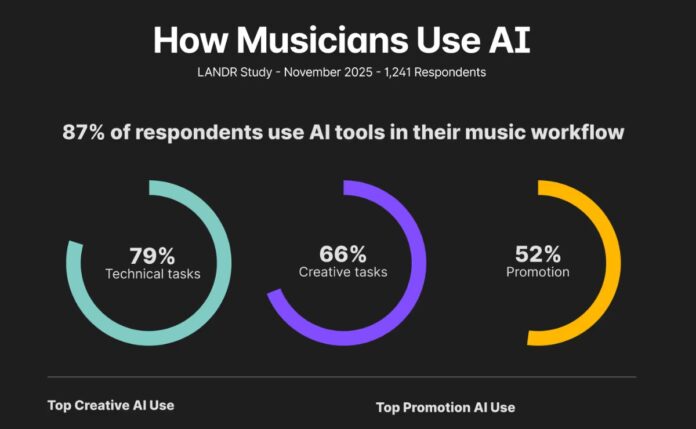
87% of respondents say they use AI in their workflows
That suggests an overwhelming majority of artists and producers are open to using AI to produce music in some way.
Of course, the numbers paint a clearer picture as to why, when broken down by use case.
Of the respondent pool:
- 79% use AI for technical tasks like mixing, mastering or audio restoration
- 66% use AI creatively for songwriting, melodies, instruments or vocals
- 52% use AI for visual and promotional work such as cover art, captions and fan analytics
Knowing that AI-powered mastering tools (like LANDR Mastering) are advanced enough to nearly match the output of a human mastering engineer, it makes sense that a high proportion of respondents say they use AI-powered tools for technical tasks.
But AI mastering is not a recent development. It first entered the market more than a decade ago, when LANDR launched its initial AI mastering tool, which led to its widespread adoption.
So, when 66% of respondents say they use AI as a creative aid and 52% say it’s helping with promotion work, it hints that the next opportunities for AI lie in those departments.
Based on the study, here’s what we understand about how artists use AI in those areas and how they see it helping in the future.
84% of respondents said they wanted to use AI for promotional activities
Even though 55% of artists who use AI said they use it for promotion-related activities, nearly all respondents felt that it could help more than it already does.
The majority of existing usage within the promotion category was centered on album art creation, with 30% of artists having tried it at least once.
But when asked where AI could help in the future, more than 80% of respondents said AI could help with social media and video content, whether for conception or image and video generation.
Another 80% also felt that AI could help them reach their audience, analyze release and social media stats and advise on fan building.
29% AI to generate music in some form, but full song generation isn’t as appealing
29% of all respondents said they use AI to generate vocals, drums or other instrumentals, but only 13% used a tool to produce an entire song.
Perhaps that’s not so surprising, considering that producers by default are experts who enjoy the practice of music creation.
Despite full-song generation becoming popular in the wider mainstream, it’s clear that artists and producers are more interested in generating parts of a song to complement their existing arrangements.
In particular, 16-18% of respondents already used AI to generate vocals, instrumentals and beats for existing arrangements and 65% said they were open to using generators at some stage in their workflow.
It makes sense, considering that most producers don’t have skills in all areas of music, and working with a session musician can be costly, challenging and time-consuming.
But when it comes to generating a full track, artists are more likely to shy away, looking instead to the inspiration and skill gap-filling features that AI generators offer.
Views on AI’s role in music are still polarized
Despite all the excitement around AI and the possibilities it promises, there are still concerns and a minority of detractors.
Of the 31% who said they weren’t using more AI tools than last year, 76% said they had no plans to use it more in the future.
Compare that with the following: of the 69% who were using more AI this year, 90% said they would continue adding AI tools to their workflows in the future.
But even those who use AI have concerns about AI’s impact.
More than 40% of respondents said they had concerns about low-quality output and the ethics and legality of using AI trained on humans.
Those are all valid concerns, of course, but knowing that AI is here to stay and that artists are demanding more from it, the bigger question is: how are music tech companies addressing these concerns?
Pioneering new AI frontiers
LANDR is one company to look to for guidance on AI and its use in music production.
It knows firsthand how much artists crave smart tools that make demanding, complex music production tasks much easier.
With its current lineup of AI-powered tools like its mastering plugin, chord generator, stem splitter and vocal enhancer, the company is committed to a vision of AI helping artists hand-in-hand.
LANDR also seems committed to this path with its Fair Trade AI program. This initiative offers artists the opportunity to earn more royalties when opting their music into LANDR’s training data sets.
Of course, there are still many opportunities and much demand for smarter AI tools that can help artists create music and grow their careers.
So we expect to see all kinds of new and interesting AI-powered tools from LANDR going forward.
AI isn’t going anywhere
The core lesson from LANDR’s recent study is simple: AI is full of possibilities for a wide range of different approaches to making music.
87% of producers are already using AI-powered tools, confirming that AI is a critical component of the modern music business.
If you’re still not using it, you may be missing out on some major improvements to your workflow.
Yes, platform guidelines around distributing AI-generated music are shifting, but leveraging AI for creative assistance is certainly not off the table.
Music promotion is one of the most exciting AI use cases right now. It’s why over 80% want AI for social content and fan analytics, and it’s clear this is where we’ll see the next major growth hacks for modern independent artists.
Concerns about ethics and quality are real. That’s why the focus must be on platforms like LANDR, which offer high-quality, ethical solutions like their Fair Trade AI program.
Ultimately, the question is no longer if you’ll use AI, but how you’ll select the right tools to build a smarter, more profitable career.